
#45 Who does a territory brand speak to? Seven audiences, three ways to persuade

In short: a territory brand does not speak only to visitors. It speaks to seven audiences: four core audiences described by Philip Kotler in 1993 (visitors, residents and workers, businesses and investors, export markets) and three relay audiences (relays and prescribers, funders and decision-makers, internal players). Each is persuaded by a dominant lever: emotion (pathos), credibility (ethos) or proof (logos).
Updated October 12, 2026. By François Veauleger, managing director of Agence Alps.
What is a territory brand?
A territory brand is the set of promises, proofs and stories that lets a place (a town, a group of municipalities, a region, an island, a destination) be identified, chosen and recommended by its different audiences. This is the definition Agence Alps uses in its work. When people say “territory brand”, they think visitors. They go for the inert triptych of logo, title and advertising tagline that elected officials love to show local dignitaries as proof that the territory is moving forward. In reality, that is only one audience out of four. And it is not the only one that decides whether your territory is attractive.
What are the four core audiences of a territory brand?
Philip Kotler and his co-authors set out four audiences in Marketing Places, published in 1993, a book worth (re)reading for much more detailed population segments: visitors, residents and workers, businesses and investors, and export markets. Each looks for something different in a territory and is persuaded in a different way.
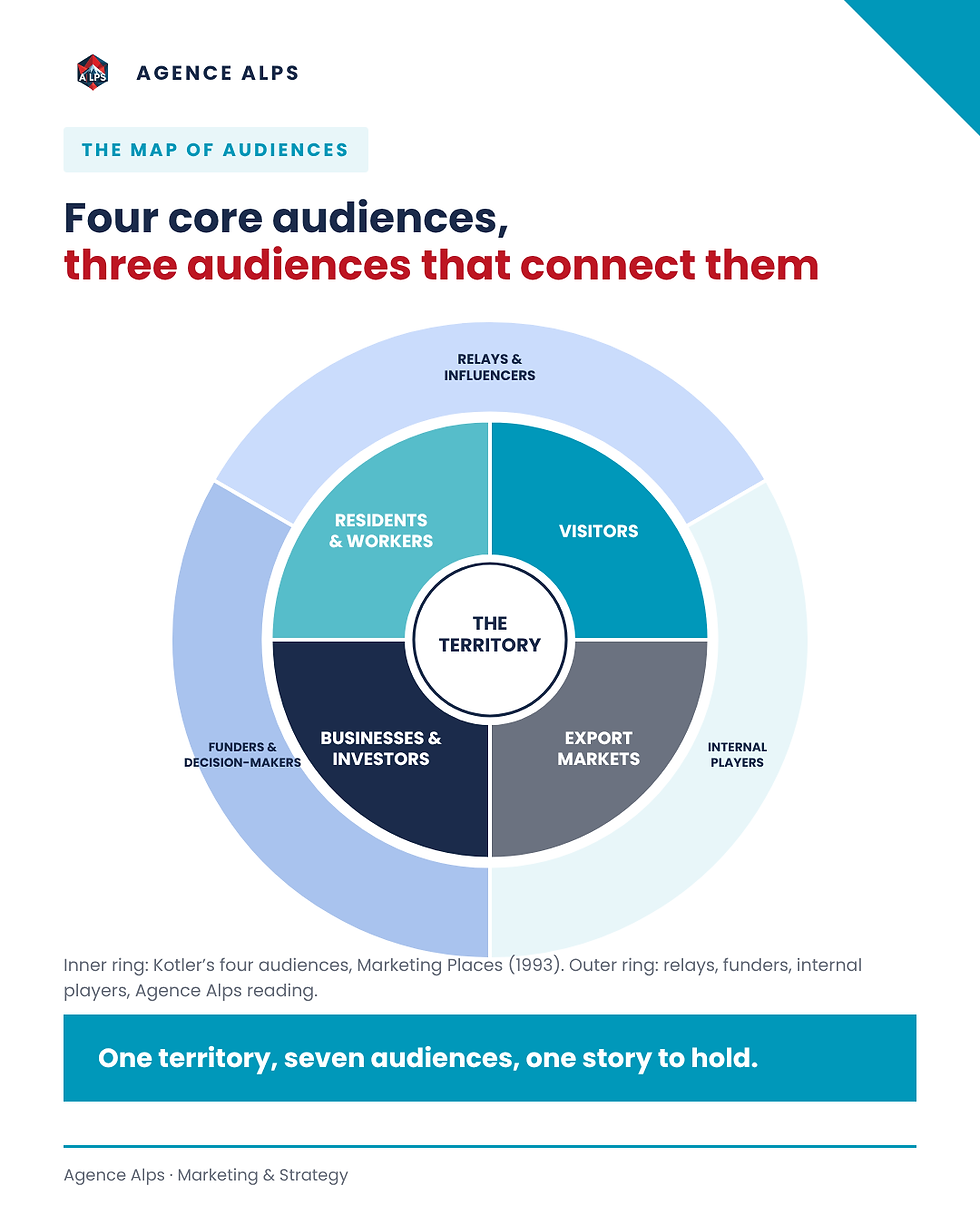
The table below sums up what each audience expects and the lever that persuades it first. The balance between emotion, credibility and proof is Agence Alps' reading, not data from a study.
Audience | What it expects from the territory | Dominant lever |
Visitors | A place that makes you want to go: an image, an experience, a promise | Emotion (pathos) |
Residents and workers | Services, a job, a good quality of life | Credibility (ethos) |
Businesses and investors | Facts: available land, an administration that answers fast, figures | Proof (logos) |
Export markets | An overall reputation, built over time | Credibility and proof (ethos and logos) |
 | What do visitors look for in a territory brand?Visitors (tourists, business and event clienteles) first choose a place that makes them want to go: they are won over with an image and an experience. They are the audience everyone sees, the one brand campaigns think of by default. They respond above all to emotion. But the one we see the most is not the only one. |
Why are residents and workers an audience in their own right?Residents and workers are the people a territory wants to keep or attract, including students and young graduates, whose departure is a real test. They are kept with services, a job and a good quality of life. Above all, they judge the brand on what they live every day, not on what they are told. For them, it is a matter of credibility. | 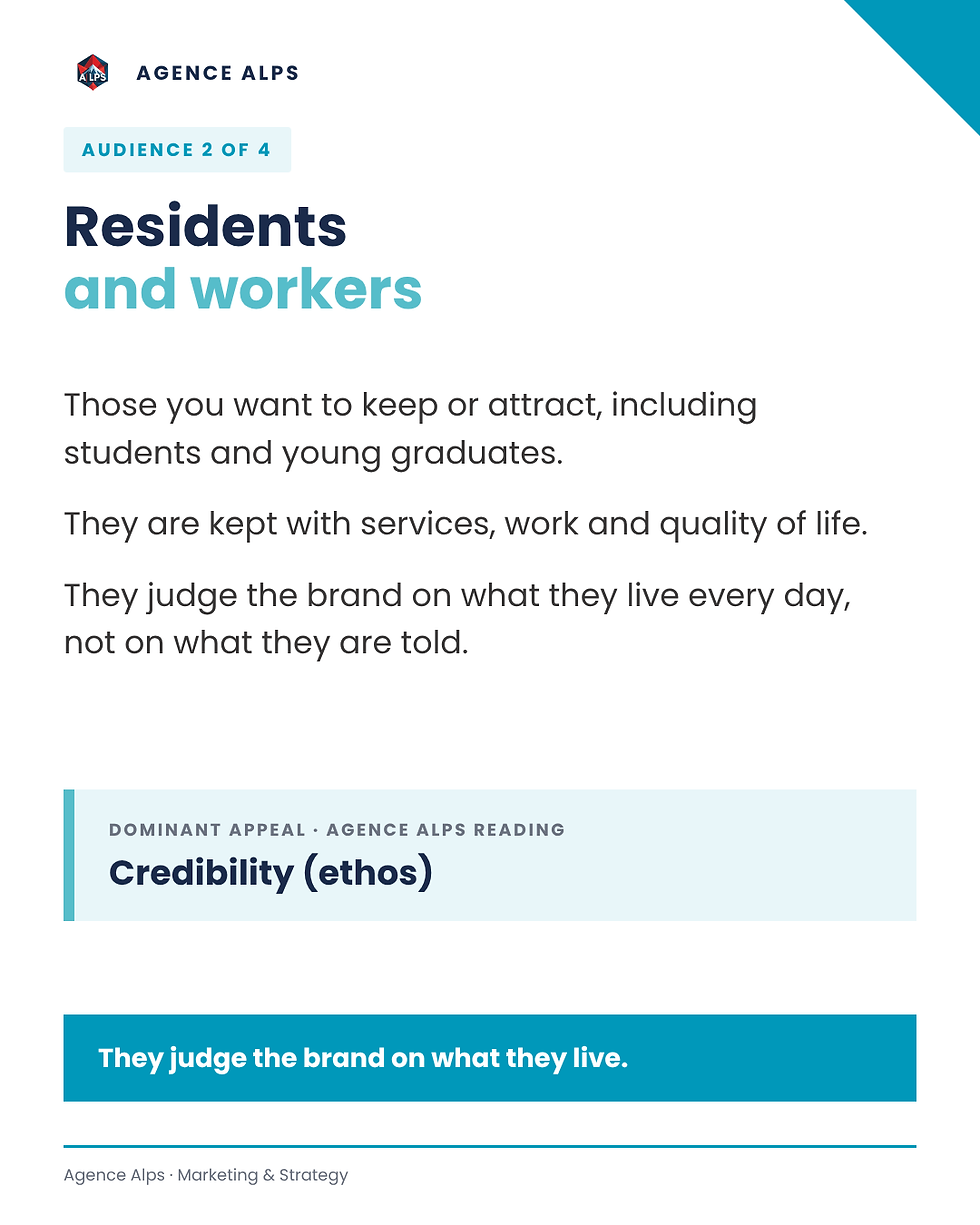 |
 | What do businesses and investors want?Businesses and investors (employers, founders, project owners, developers) are reassured by facts: available land, an administration that answers fast, figures. A nice image is not enough to convince a company to set up. This audience expects proof. |
How is a territory's reputation built on export markets?Export markets are the outside markets where the territory makes its sectors and products known. They are won with an overall reputation, built over time. Seen from afar, real awareness may have nothing to do with the awareness we credit ourselves with: everything rests on credibility and proof. | 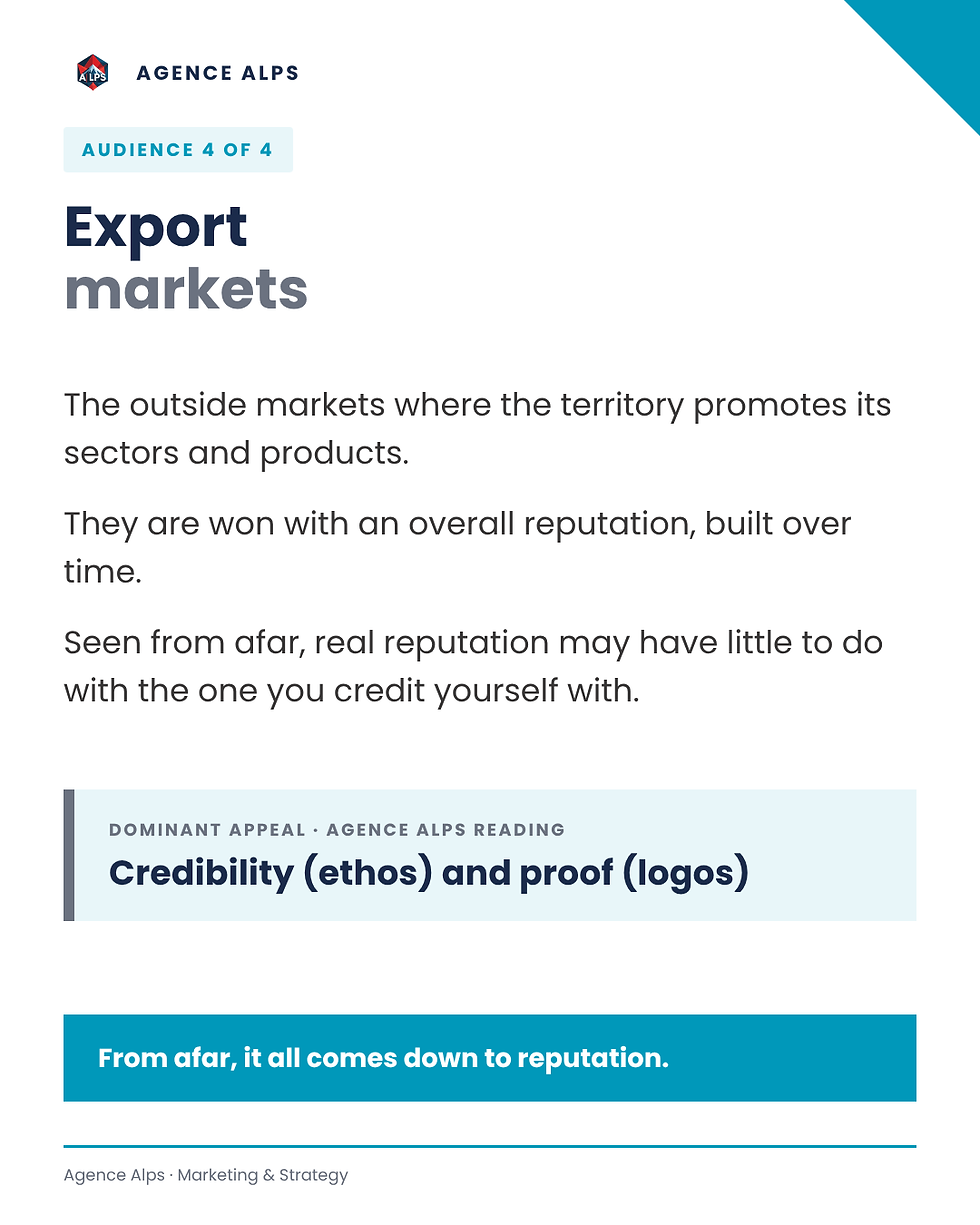 |
What are the three relay audiences of a territory brand?

Around Kotler's four audiences, Agence Alps' reading adds three that are often forgotten:
Relays and prescribers: media, tour operators, agencies, organisers. They tell the territory's story in your place.
Funders and decision-makers: elected officials, the State, the Region, Europe, Africa. They award budgets and rankings.
Internal players: trade bodies, associations, staff. They carry the brand day to day, or contradict it.
These three audiences are not your end customers. They decide what happens next. This extension is Agence Alps' reading, not a validated typology.
What are pathos, logos and ethos in Aristotle?
In the fourth century BC, in his Rhetoric, Aristotle set out three means of persuasion for a speaker:
Pathos: the emotion stirred in the audience.
Logos: proof, the rational argument.
Ethos: the credibility of the person speaking.
How do you apply pathos, logos and ethos to a territory?
Each audience calls for a different balance. Applied to a territory, this gives a square of application: visitors respond first to emotion. Residents judge the brand on what they live, it is a matter of credibility. Businesses and investors want proof. Export markets buy a reputation, made of credibility and proof.
At the corners of this square, if one angle is forgotten, the message limps. Emotion without proof promises without convincing. Proof without emotion informs without making people want. Credibility alone introduces itself, without saying anything.
Why is ethos the hardest to master for a territory?
In the Rhetoric, the speaker is alone in speaking. A territory has hundreds of voices: residents, entrepreneurs, associations, staff, elected officials, visitors back home. A territory's ethos therefore cannot be decreed from the local authority. It is shared among everyone who talks about the place.
Residents and internal players are therefore not just one audience among others: they are also the brand's spokespeople. A brand that speaks well to visitors but is not recognised by its own residents loses its credibility exactly where it needs it most.
How do you choose which audience to speak to first?
A single message for seven audiences risks convincing none of them. The work starts with choosing, in four steps:
List the territory's seven audiences.
Choose the audience you speak to first.
Choose the mix of emotion, proof and credibility that suits that audience.
Identify who carries the message to them.
A simple test: take your last brand presentation and underline who it speaks to. Out of these seven audiences, how many do you find?
What are the limits of this reading grid?
This is a reading grid, not a study. The four core audiences come from Kotler. The balance between emotion, proof and credibility, and the three relay audiences, are Agence Alps' reading. Aristotle spoke to citizens gathered in an assembly, and the “triangle” of pathos, logos and ethos is a teaching device that came much later. Finally, audiences overlap: a visitor can become a resident, then an investor, and a figure can move people as much as an image.
Frequently asked questions about territory brands
Who does a territory brand speak to?
To seven audiences: four core audiences (visitors, residents and workers, businesses and investors, export markets) and three relay audiences (relays and prescribers, funders and decision-makers, internal players).
Who defined the four audiences of a territory brand?
Philip Kotler and his co-authors, in the book Marketing Places, published in 1993. The three relay audiences are an extension proposed by Agence Alps.
Does a territory brand only serve tourism?
No. Visitors are only one of the four core audiences. Residents, businesses, investors and export markets play an equally decisive role in a territory's attractiveness.
What is ethos for a territory?
It is its credibility. It does not depend on a single spokesperson: it is built among everyone who talks about the place, residents, entrepreneurs, associations, staff and elected officials.
Why can't a single message convince every audience?
Because each audience is persuaded by a different dominant lever: emotion for visitors, credibility for residents, proof for businesses and investors, credibility and proof for export markets.
Your turn
In your territory, which audience is the great forgotten one? Tell us in the comments: just one audience, and why.
Agence Alps is a marketing and strategy agency based in Saint-Leu, Réunion Island, working from the Alps to Southern Africa and the Indian Ocean.


Comments