
#44 VRIO: Of Your Four Best Assets, Only One Is a Real Competitive Advantage
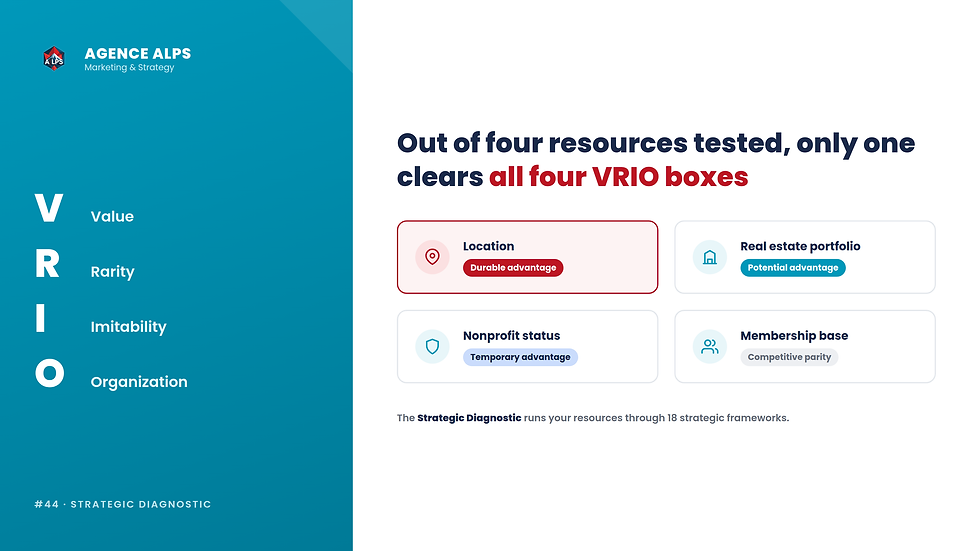
Four sites, over two million euros in real estate acquired in a single year, a cash reserve above one million euros. On paper, a social tourism association we worked with has everything going for it. Run through the VRIO framework, only one of these assets turns out to be a genuine, durable competitive advantage. The other three are either easy to copy or already shared by everyone else.
VRIO: Four Questions That Separate Real Strength From Wishful Thinking
Most strategic diagnostics stop at a list of strengths. VRIO goes further by putting every resource or capability through four sequential tests: does it have Value, does it meet a customer need or cut a cost; is it Rare, do few competitors hold it; is it hard to Imitate, could a rival reproduce it easily or cheaply; is the Organization in place to actually capture it.
A resource that fails the first test is a competitive disadvantage. Valuable but common, it's competitive parity. Valuable, rare, but imitable, it's a temporary advantage. You need all four boxes checked, including organization, to call it a durable advantage. That last box is the one most organizations never actually check.
A Real Case: Four Resources, Four Different Verdicts
This association runs four holiday centers, two by the coast and two inland at altitude. Its strategic diagnostic ran VRIO against its main resources, with strikingly uneven results.
The real estate portfolio (4 sites, 2.08 million euros acquired in 2024) clears the first three hurdles: it has value, it's rare in its market, and it's hard to replicate. Verdict: potential durable advantage, provided its use is properly organized.
The dual location, coastal for two sites, mountain for the other two, follows the same path: durable advantage.
Its nonprofit (ESS) status, which enables 15-20 euro annual membership and 70 euro nightly rates, has value and rarity, but any association could adopt the same model tomorrow. Temporary advantage at best.
Its historic membership base, roughly 250 active members tied to its founding partners, has value, but nothing locks members in. Plain competitive parity.
The Box Everyone Forgets: Organization
This case shows exactly why VRIO's fourth box is the most neglected, and the most decisive. The real estate portfolio checks Value, Rarity, and Inimitability. But the diagnostic flags Organization as still needing work: of the four sites, one, with 125 beds, remains largely underused for lack of active marketing to groups and school programs.
Owning a rare, hard-to-copy resource isn't enough. Without the staff to run it, roughly a dozen employees across four scattered sites according to the diagnostic, and without a dedicated sales strategy, the potential advantage stays on paper. That's the difference between an asset and a real competitive advantage: one is built, the other can sit dormant on a balance sheet for years without ever creating value.
It's exactly the kind of gap a structured diagnostic catches before it costs an entire season.
Now What?
Listing what your organization owns is easy. Knowing which of those assets is a genuine competitive advantage, and which is just an ordinary resource dressed up as a strength, takes a tougher grid.
Agence Alps' Strategic Diagnostic runs VRIO alongside 17 other strategic frameworks (Porter, PESTEL, 7S, SWOT 2.0, VPC...), built entirely from your organization's public data: government registries, corporate filings, insolvency records, Google reviews. In about an hour of processing, you get an actionable thesis on which resources actually matter, and which don't.
Want to see what a VRIO run reveals about your own organization? Let's talk.


Comments