
#4 Do Culture and Tourism go well together?
- Francois Veauleger

- Jan 17
- 6 min read
In philosophy, the word culture denotes that which is different from nature. Culture has long been considered a characteristic feature of humanity, which distinguished it from animals.for an international institution like UNESCO: “In its broadest sense, culture can today be considered as the set of distinctive, spiritual, material, intellectual and emotional traits that characterize a society or a social group. It encompasses, in addition to the arts, letters and sciences, ways of life, laws, value systems, traditions and beliefs.” This “common reservoir” evolves over time through and in the forms of exchanges. It is constituted in multiple distinct ways of being, thinking, acting and communicating in society.
Here is the definition that we find of Culture in Wikipedia today.
But in fact, even if culture uses a very broad field, it is still well oriented towards heritage and the arts in the collective imagination. The General Management of Companies will tell us the following facts about the sector:
With more than 8,000 museums including 1,200 “Museums of France”, 1,500 festivals, 44,000 classified and registered historical monuments, 40 cultural sites included on the UNESCO world heritage list, exceptional parks and gardens and internationally recognized know-how, the cultural and heritage offer represents one of France's main tourist assets.
The weight of this sector is estimated at nearly 100,000 jobs and 15 billion euros in economic benefits.
In return, tourism constitutes the primary route of access to culture since it generates more than 60% of the attendance at these sites. In France, tourism and culture are two complementary themes. Indeed, if tourism professionals exploit the cultural wealth of a destination to increase its attractiveness and generate economic benefits, tourist attendance also contributes to the survival of cultural sites. This is one of the main reasons for staying for French and foreign tourists, regardless of their country of origin.
Beyond large metropolises, tourist numbers generated by cultural sites have a direct impact on the economic development of territories, whether in terms of jobs and economic revenue. Thus, culture has become the catalyst for local tourism strategies.
Aware of the weight of cultural tourism in France and the need to undertake coordinated actions to develop this sector, the ministries responsible for culture and tourism updated a framework agreement on January 19, 2018. The aim is to provide France with a more offensive strategy to increase tourism economic benefits through the promotion of cultural sites and events.
Source: DGE website
Cultural tourism is well taken into account by the DGE in French tourism policy, a natural fact in view of the audiences that major French cultural sites have received in recent years...
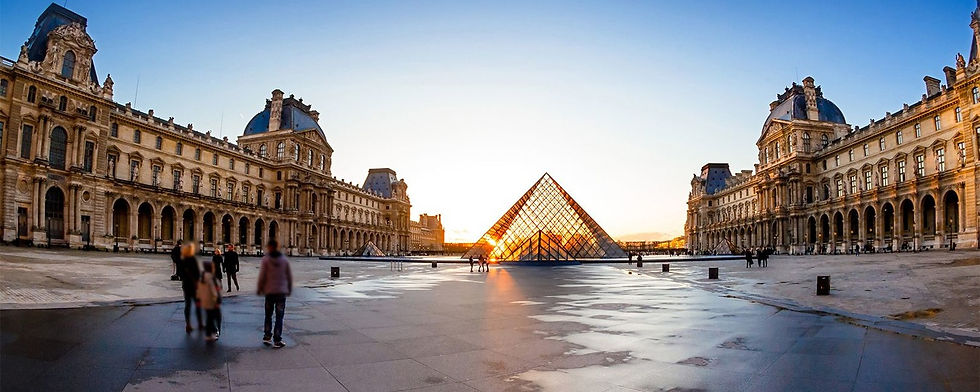
The Louvre Museum 8.1 million visitors (+9.5% compared to 2016)
The Palace of Versailles with 7.7 million (+15.1%)
The Eiffel Tower is in third position with 6.2 million visitors (+5.6%)
Mont Saint Michel: 2.5 million in 2016
The Pont du Gard - 1,201,000 visitors
Audiences are very good and even increasing for certain sites and it is clear that French history and heritage are a real asset for national tourism and facilitate France's appeal to international populations.
BUT ART AND CULTURE ARE NOT EVERYTHING...
Even if art is for everyone to wear, I would like to return to an annoying French habit, of trying to put a more or less successful work of art on each roundabout in France. I reassure you right away, this is not what will attract new tourists to your territory tomorrow...
Art is defined in several families according to a classification of the arts, established in 1969 by the philosopher Étienne Souriau based on seven sensory characteristics.
Architecture
Sculpture;
Visual arts (painting, drawing, etc.);
Music ;
Literature (poetry or dramaturgy);
Performing arts (theatre, dance, mime, circus);
Movie theater ;
Some add like 8th art, television and television series.
I would give a dynamic vision of culture through the arts. The arts have the capacity to appeal to the imagination of each individual, and this is perhaps what tourists come to look for in cultural tourism. So our roundabout is far away...
Numerous examples show us the interest in the use of culture within territories.Four days and 280,000 spectators, the organizers of Vieilles Charrues are delighted with the results of their “colossal” 2018 edition, which is unexpected for the small Breton town of Carhaix.But the joy of a successful edition does not prevent vigilance for the future. “Our festival must find a solution to reduce the financial risk,” Jean-Luc Martin, president of the festival, underlined during a press conference. “There is the equivalent of a French stadium in Carhaix. We can host events outside of July,” he underlined, recalling that each evening, the Kerampuilh plain welcomed around 70,000 people. Managed by a non-profit association and relying on a network of 7,000 volunteers, the festival must sell 205,000 tickets to break even. The sale provides 80% of its budget, the remaining 20% coming from partners or patrons.“The Charrues economic model is becoming an exception in a sector undergoing rapid change between the concentration of the environment and growing competition,” notes Jérôme Tréhorel.
We cannot therefore generalize a success like the Vieilles Charrues to all cultural events, too many factors come into play to make these events a success or not. With this, the question arises of managing the injection of so many visitors at the same time into a territory. Are the roads made for it? Are the health and safety conditions met? Basically how to succeed in tourist reception...
SO HOW TO USE CULTURE WITHIN YOUR TOURIST STRATEGY?
Whether through natural or cultural heritage, whether through art, it seems to me that the interest of the territory is to play the authenticity card. Let me explain... A mountain area could use cultural facilities around water as a tourist tool, as Saas Gründ does in Switzerland with its water trail around well-being in the mountains since it is a local natural resource. The Bordeaux castles and wine tourism in Médoc Atlantique are also a very good example of the adaptation of tourism to local resources. There is no point in pushing the point, cultural tourism can only work if the terrain is suitable for it.
"The emergence of new forms of tourism, such as gourmet tourism, solidarity and fair tourism or even cultural tourism, testifies to the constant broadening of tourist intentions and questions their social meaning. In addition to the resulting increasing complexity of the tourist field, we are witnessing the multiplication of destinations. All places, whatever their scale – from restaurants to ecological parks via entire cities – or whatever their location – from the neighboring neighborhood to the country located on the other side of the planet – are likely to become destinations are now without geographical or physical limits, new forms of tourism are also ways of going beyond symbolic, imaginary, cultural limits. If new destinations are offered, old ones are also capable of constantly being renewed, so that the dynamic of change in turn opens up infinite possibilities. says Jean-René Morice in his book – Heritage, a tool for boosting tourism in villages? -
BUT COULD NOT TOURISM ALTER CERTAIN SITES BY TOO MUCH VISITORS?
We previously talked about Mont Saint Michel, the first French tourist site after Paris, which today encounters many problems caused by cultural tourism.Overloaded transport, congested roads, poor services on the site... Two reports highlight the failures of a site which has lost a million visitors in a decade.The reception conditions at Mont Saint Michel and their financing are highlighted in two reports, one from the Regional Court of Auditors (CRC), the other from the Regional Economic and Social Council (CESER). “A series of dysfunctions and problems recurrently emerge regarding tourist reception” on this UNESCO World Heritage site.Although the site remains one of the most visited in France outside the Paris region, it has lost some 1 million tourists in recent years. There were 3.5 million each year at the end of the 2000s according to UNESCO to visit the abbey listed as a UNESCO world heritage site, there were only 2.5 million in 2016.
But new visions of agreement between tourism and culture are currently emerging. During the completion of the arrangements intended to welcome the public to the Louvre Museum, Jean-Luc Martinez, its general director, observed, on July 6, that “tourism is changing”. “The question is no longer so much about increasing the number of visitors [according to the DEPS, in 2015 the Louvre retained its position as the busiest museum in the world with 8.7 million visitors even if this number is down compared to 2014 (Editor's note)] as it is about knowing how to welcome them and help them learn as much as possible from their visit. The main thing is to offer our visitors a more welcoming, more accessible and more generous Louvre,” he added.
At a time when certain sites are complaining about the excesses of mass tourism, the influx of visitors to tourist sites with a cultural orientation can also raise the same questions. Isn't it time to favor the quality of welcome more than its quantity? Should we not take into account premature wear and tear due to public traffic? Isn't it time to integrate an environmental concept into all tourism policy in order to derive a concept of sustainability?


Comments